
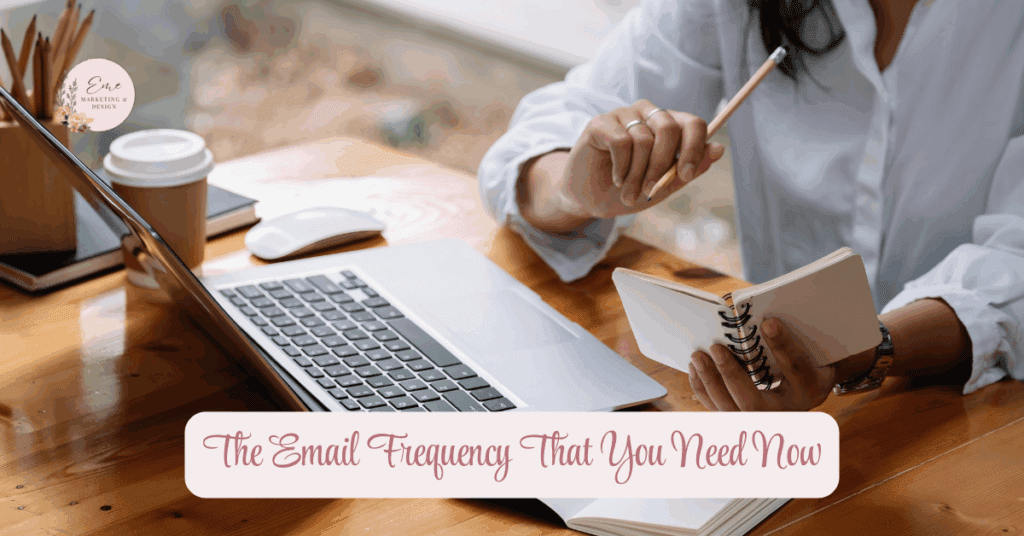
Email marketing is one of the most powerful tools a woman entrepreneur can use—but it only works when you strike the right balance between “staying present” and “annoying your audience.” In this blog we’ll dig into what the data says about email frequency, why it matters for your business, and actionable steps you can take now to dial in your cadence and keep your list engaged (rather than opting out).
Why Email Frequency Matters
Think of your email list as a relationship. If you never show up, people forget you. If you show up too often, you feel like the over-eager acquaintance who drops by unannounced. Both hurt your connection and ultimately your business.
Here’s why frequency matters:
- Too few emails → Your brand becomes invisible, you miss revenue, and your list may go stale.
- Too many emails → Subscribers get fatigued, open rates drop, unsubscribes rise, and you risk deliverability problems.
- The “sweet spot” shifts depending on your business model, audience and content type.
For you—as a woman entrepreneur managing your brand or your clients’ brands—finding that sweet spot means less guesswork and more results. Let’s jump into what the data says.
What the Data Tells Us: Industry Benchmarks
Here are benchmark numbers to guide your thinking. Remember: these are starting points, not gospel.
1. Consumer / eCommerce / B2C
- One to three emails per week tends to be optimal for many e-commerce brands.
- Sending too many weekly—especially without varying content—leads to diminishing returns.
- Example: A boutique sells seasonal accessories. They find that sending 2 emails/week (one style inspiration + one limited-time offer) keeps engagement high. 4-5 emails/week causes unsubscribes.
Action item: If you’re in B2C, start with 2 emails/week. Monitor unsubscribes/open rates after 6-8 weeks.
2. Service-oriented / B2B / Longer sales cycles
- These audiences generally prefer less frequent contact: 1–2 emails/month or low single-digit per month.
- Example: You offer a social media coaching program for women entrepreneurs. Sending weekly sales-oriented emails might feel pushy. Instead, monthly deep-dive content + occasional promo works better.
Action item: If you’re promoting higher-ticket services, aim for 1 email every 2–4 weeks, then test moving to 2 per month if acceptable.
3. Mixed / Hybrid models
If you have both product and service offers (maybe you’re selling digital courses + coaching), you may need a blended cadence. Visibility via weekly value content, but promotional offers less often.
- Example: You send a weekly tip email (value) and a sales email every 3-4 weeks. The weekly keeps you top-of-mind; the promo drives revenue without overwhelming.
Action item: Map your content types (value vs. promo) and schedule accordingly—e.g., 1 weekly value + 1 monthly promo = ~5 emails/month.
The 5 Key Factors That Influence Your Ideal Email Frequency
Let’s look at what impacts your “right” number and how you, as a woman entrepreneur, can tweak each factor.
Factor 1: Audience Preference
Your list isn’t monolithic. Some subscribers are highly engaged and excited to hear from you often—others want minimal contact.
- Data: Giving subscribers choice (via a preference centre) helps reduce churn.
- Example: One of your clients runs a wellness brand for women 30–65. They include a preference option: “Receive once a week / once every two weeks / only when special offers.” People self-select.
Action item: Create an email-preference centre in your email platform so subscribers can pick how often they want to hear from you.
Factor 2: Engagement Levels & Segmentation
Highly engaged subscribers can tolerate (and even appreciate) more frequent emails. Low-engagement subscribers may need less frequent contact to avoid pushing them away.
- Data: Segmenting by engagement helps tailor frequency.
- Example: For your offerings to female entrepreneurs:
- Segment A: Bought a course recently → send weekly updates.
- Segment B: On mailing list but never bought → send bi-weekly value emails, monthly offers.
- Segment A: Bought a course recently → send weekly updates.
Action item: Use your CRM or email tool to segment your list into “High-engagement,” “Medium,” and “Low/no engagement.” Adjust cadence per segment.
Factor 3: Content Type & Value
If every email gives high value (education, inspiration, connection), you can send more often. If it’s promo heavy, you’ll want to space them.
- Data: Quality matters more than volume.
- Example: You run an email for women entrepreneurs with content like “This week’s quick social-media audit” + “30-minute strategy tip.” That’s value-laden, so weekly works. On the other hand if it’s “buy my course” each time, send less often.
Action item: Audit your last 8 emails: how many were real value vs. pure offer? If value < 50 %, reduce promo frequency.
Factor 4: Purchase/Interaction Cycle
How often your customers buy or engage heavily influences cadence. More frequent purchases allow more frequent emails.
- Data: In e-commerce higher purchase frequency supports 1-3 emails/week.
- Example: If your business is selling monthly subscription boxes for women’s wellness, you may send weekly: e.g., “How to use your box,” “Add-ons,” “Free tip.” If you sell a one-time premium coaching package, you’ll send less.
Action item: Chart your typical customer lifecycle: first contact → first purchase → repeat purchase. Then align email cadence to those phases.
Factor 5: Testing & Metrics
Benchmarking helps but your results matter most. Track opens, clicks, unsubscribes, spam complaints, revenue per email.
- Data: Many sources say test and adjust. For example, reducing frequency from daily to 3×/week improved results.
- Example: You try sending 3 emails/week vs. 1 email/week for a 2-week period to different audience segments, then compare open rate and revenue.
Action item: Set up a schedule of testing: choose 2 cadences to test (e.g., weekly vs. bi-weekly) for 6 weeks. Track key metrics and pick winner.
Putting It All Together: A Sample Email Cadence Roadmap
Here’s a step-by-step roadmap you can follow to dial in your cadence for the next 90 days.
First Month – Baseline & Preference Setup
- Send a survey email: ask your audience how often they’d like to hear from you (weekly / bi-weekly / monthly).
- Set up your preference centre and update your list segments (High, Medium, Low engagement).
- Choose a baseline cadence. If you’re in B2C: try 2 emails/week. If B2B/service: 1 email/month + 1 monthly follow-up.
- Track opens, clicks, unsubscribes, revenue per email.
Second Month – Segment & Content Type Optimization
- For High engagement segment: test increasing to 3 emails/week (if B2C) or 2 emails/month (if service).
- For Low engagement: reduce to 1 email/week or every 2 weeks, focus strictly on value-first content.
- Audit content: ensure at least 60 % of your emails are value-based (how-to, stories, tips) vs. pure offers.
- Begin A/B testing frequency: e.g., for one segment send every Monday vs. Monday & Thursday.
Third Month – Review & Adjust
- Pull metrics: open rate, click-through rate, unsubscribe rate, spam complaints, revenue.
- Identify segments/segments that are underperforming. Reduce frequency or refine content.
- For segments performing well (higher opens, more clicks, high revenue), you may cautiously increase frequency by 1 extra email/week or month.
- Document your cadence success—what worked for the majority—and make it part of your ongoing strategy.
7 Common Mistakes to Avoid (and How to Fix Them)
Let’s cover some pitfalls I’ve seen many entrepreneurs fall into—and how you can steer clear.
- Mistake: “If I send more emails, more chances to sell.”
Fix: More isn’t always better. You’ll erode trust and drop engagement. Focus on value, not volume. - Mistake: “One size fits all.”
Fix: Segment your list by behavior. High-value, loyal subscribers get different cadence than new or inactive ones. - Mistake: “I’ll just send the same weekly email forever.”
Fix: Mix up content (value vs. promo vs. story) and revisit frequency monthly via data. - Mistake: “Ignore preference. I know best.”
Fix: Let subscribers pick how often they hear from you. That builds loyalty and reduces unsubscribes. - Mistake: “If I send less frequently I’ll lose momentum.”
Fix: Consistency matters more than frequency. A monthly email that delivers value is better than weekly with fluff. - Mistake: “I have one list, no segmentation.”
Fix: Start small: segment by “purchased vs. not,” “opened vs. dormant.” Tailor cadence from there. - Mistake: “Once I pick a cadence I’m done.”
Fix: Your audience changes. Regularly revisit and test. What works today may not work next year.
Real-Life Mini Case Study
Meet Sara. She’s a woman entrepreneur running a personal branding consultancy for women 35–55. Her list has 5,000 subscribers, mainly those who downloaded her free “Brand Audit” guide.
Initial model: She was emailing once/week: value blog + occasional pitch once/month. She saw decent opens (~22 %) but very low click-through (~1.2 %) and few conversions.
What she did:
- Surveyed her list: most said they’d like 2 emails/week—one tip and one story/testimonial.
- She segmented:
- Segment A: Active clients & past buyers → 3 emails/week (Monday: industry tip; Wednesday: client story; Friday: offer).
- Segment B: List but never bought → 2 emails/week (Tuesday: value; Thursday: soft invite to webinar).
- Segment A: Active clients & past buyers → 3 emails/week (Monday: industry tip; Wednesday: client story; Friday: offer).
- After 8 weeks: Segment A open rate jumped to 28 %, click-through to 3.5 %. Segment B unsubscribes dropped by 30%. Conversions increased by 45%.
- She adjusted: kept 3/week for Segment A, moved Segment B to 1 email/week when they didn’t yet convert.
Takeaway: By aligning frequency with engagement level and value content, Sara increased results and minimized fatigue.
Your Action-Checklist
- Create a survey or preference centre asking “How often would you like to hear from me?”
- Segment your email list into at least two groups: “Highly engaged” vs. “Less engaged / new.”
- Choose your starting cadence based on your business model (B2C vs. service) and current metrics.
- Audit your last 8 emails: label them as “value” or “offer.” Ensure at least 60 % are value-first.
- Set up an A/B test: e.g., one group gets one email/week, another group gets two. Track key metrics (opens, clicks, unsubscribes).
- Mark a date in your calendar (6 weeks out) to review metrics and adjust cadence accordingly.
Final Thoughts
As a woman entrepreneur, you wear many hats. Email marketing doesn’t need to become your stress hat. It can be strategic, sustainable, and even fun. The goal isn’t “email more” but “email smarter.”
- Start with the data: industry benchmarks tell you 1–3 emails/week for many B2C business, but your audience might differ.
- Next, tailor to your list: segment, let people choose frequency, adapt to engagement.
- Finally, monitor & test: what works today may not work tomorrow. Your audience evolves. Your offers evolve. Your cadence should evolve too.
By finding your email-frequency sweet spot, you’ll build stronger relationships, drive more conversions, and keep your brand top-of-mind (without being top-of-unsubscribe-list). Let your voice be consistent, valuable, and welcomed—and your audience will thank you for it.
Here’s to sending emails that matter (not just fill inboxes).
Working with Eme Marketing
Finding your perfect email cadence isn’t just about numbers—it’s about understanding your audience, your goals, and your unique brand voice. At Eme Marketing & Design, we help women entrepreneurs craft data-driven, personality-packed email strategies that convert without feeling pushy.
Whether you need help designing an automated sequence, creating irresistible content, or analyzing your engagement metrics to fine-tune your send schedule, we’ll build a plan that fits your business—and your lifestyle. You’ll know exactly when to email, what to say, and how to turn opens into real connections.
💌 Ready to discover your email marketing sweet spot?
Let’s make your list your most powerful sales tool.
Book a free consultation today and bring a little #EmeMarketingMagic to your inbox strategy.